
Gen Z Isn’t Ready for Work.” But Who Was Supposed to Teach Them?

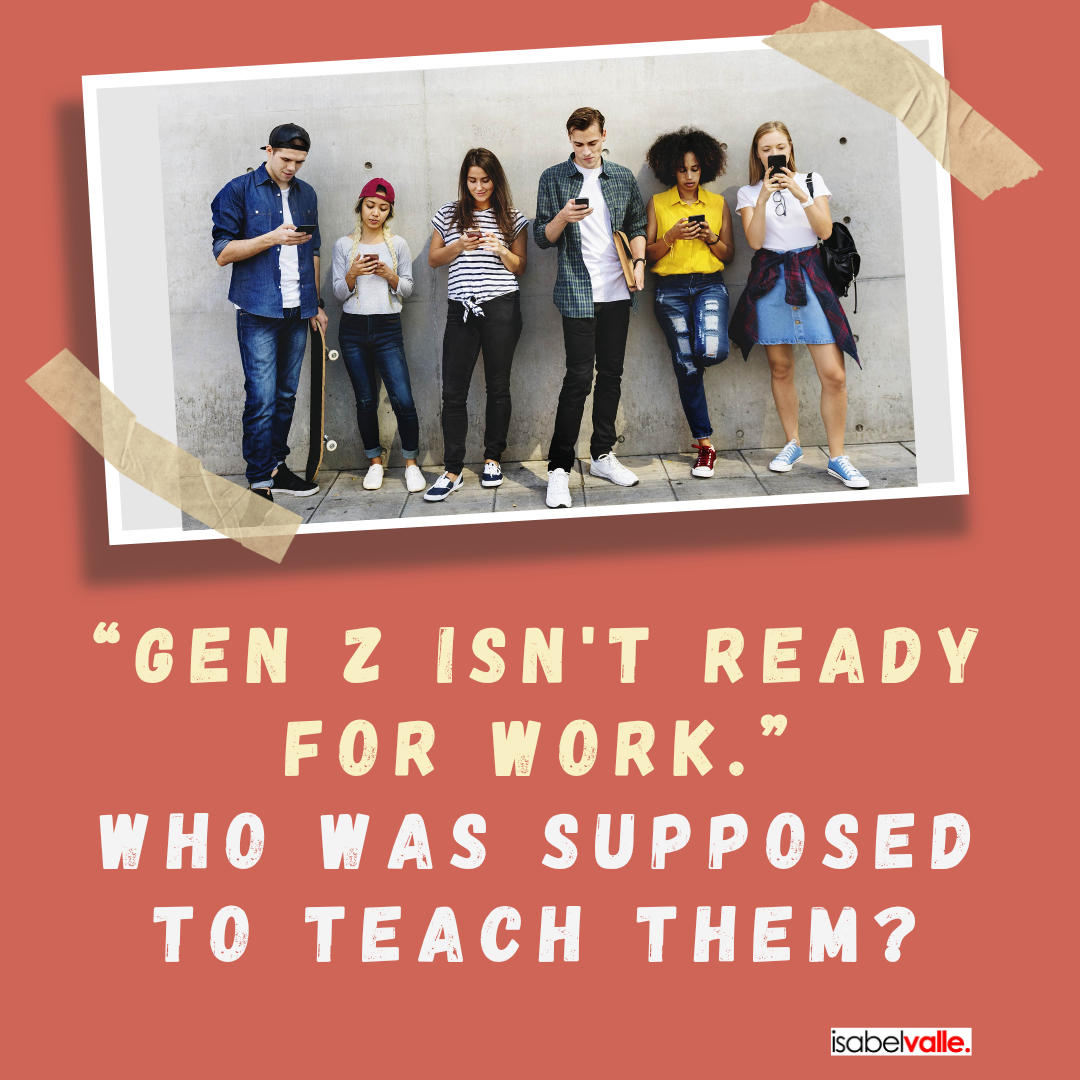
There is an increasingly heated conversation about Gen Z and the workplace.
Are they prepared?
Do they understand professionalism?
Can they communicate effectively?
Are they resilient enough?
Do they expect too much flexibility?
Do they want feedback too often?
Are they too dependent on technology?
These are legitimate questions.
But I think we’re missing a much more important one:
Who was supposed to teach them?
Recent reporting highlights growing concern among employers about the workplace readiness of recent graduates, particularly around communication, critical thinking and professional skills.
But experience doesn’t magically appear when someone receives their first job offer.
Neither does confidence.
Or judgement.
Or the ability to navigate organisational politics.
Or the ability to have a difficult conversation.
Those things are developed through experience, feedback, coaching, mistakes, observation and responsibility.
And this is where leadership has a role.
I often see organisations say they want young talent to be more proactive.
Then they micromanage them.
They want them to speak up.
Then dismiss their ideas because they’re inexperienced.
They want resilience.
But don’t create environments where people can safely make mistakes and learn.
They want accountability.
But don’t give people enough autonomy to actually own something.
Then, six months later, someone says:
“They’re just not ready.”
Perhaps they’re not.
But instead of immediately blaming the generation, let’s ask a better question:
What have we done to help them become ready?
This doesn’t mean lowering standards.
In fact, I believe we should do the opposite.
Set clear expectations.
Give direct feedback.
Teach professional skills explicitly.
Explain the unwritten rules.
Create meaningful accountability.
Give people responsibility before they feel completely ready.
Let them fail safely.
Then coach them through what happened.
That’s how capability develops.
And there is another opportunity here.
Young professionals bring perspectives that organisations desperately need: different experiences, different expectations, digital fluency and a willingness to question assumptions that older generations may have stopped questioning.
But that potential doesn’t automatically become contribution.
It needs leadership.
The answer isn’t to make Gen Z behave exactly like previous generations.
Nor is it to adapt the entire workplace around every expectation they bring.
It’s to create a workplace where different generations can learn from one another.
That requires leaders who can hold two things at once:
High standards and high support.
Accountability and empathy.
Challenge and trust.
Structure and autonomy.
That’s radically human leadership.
So the next time you hear:
“Young people today aren’t ready for work,”
pause.
Ask:
“What are we doing to help them become ready?”
Because potential doesn’t arrive fully formed.
Leadership is one of the forces that helps turn potential into capability.
And perhaps the real test isn’t whether the next generation is ready for our workplace.
Perhaps it’s whether our workplace is ready to develop the next generation.
To your success,
Isabel
Which inisght has impacted you the most? Drop it in the comments!

Isabel Valle is a Global Leadership Strategist and ICF Master Certified Coach (MCC) who helps senior leaders and organisations achieve high performance without losing their humanity.
With 25+ years of international leadership experience across Europe, Australia and Asia, Isabel combines strategic thinking, executive coaching and real-world leadership experience to help leaders build stronger leadership, high-performing teams and cultures where people can thrive.
She is the creator of LeadWise™ – Radically Human Leadership, a leadership philosophy grounded in the belief that sustainable performance starts with how we lead ourselves, develop others and shape the environments around us.
A keynote speaker, author and award-winning leadership expert, Isabel works with leaders who don’t simply want to perform better — they want to lead better, and make a lasting impact.