
AI Isn’t the Trust Problem. Leadership Is.

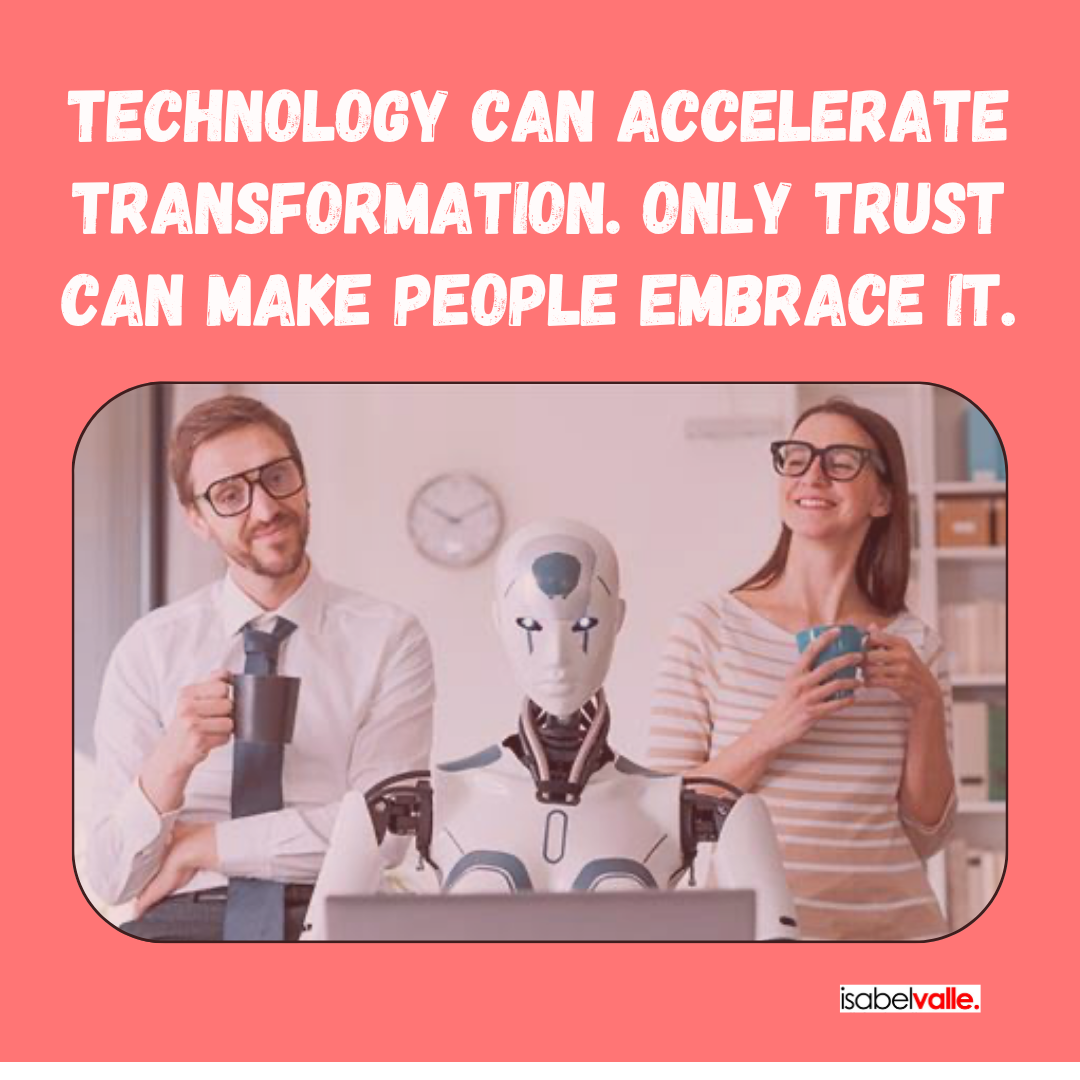
There is a question I think leaders should be asking more often as artificial intelligence becomes embedded in everyday work:
What are my people afraid will happen?
Not what you think they’re afraid of.
Not what the technology team tells you.
Not what appears in the AI implementation plan.
What are your people actually thinking?
Will AI make my role redundant?
Will I be expected to produce more with fewer resources?
Will my manager know when I’m using it?
Will using AI make me look less capable?
What happens if I make a mistake with it?
And perhaps the most important question:
What does this mean for my future here?
These are not technology questions.
They are leadership questions.
Recent Gallup research found that 50% of CHROs surveyed were not confident in managers’ ability to guide employees in using AI at work.
At the same time, McKinsey’s recent research argues that successful AI transformation depends heavily on trust, transparency and investment in people.
This matters because organisations are often treating AI adoption as if it were simply another technology implementation.
Choose the platform.
Train the employees.
Write the policy.
Measure adoption.
Move on.
But human beings don’t experience transformation as a technology project.
They experience it as uncertainty.
And uncertainty changes behaviour.
People become cautious.
They protect themselves.
They stop asking questions.
They quietly experiment rather than openly share what they’re doing.
They worry about being judged.
And when that happens, you can have excellent technology and still have poor transformation.
This is where leadership becomes critical.
A leader who says:
“Here’s exactly how this will work.”
may create compliance.
A leader who can say:
“We don’t know everything yet. Let’s learn together.”
may create something far more valuable:
trust.
That means asking different questions.
What are you excited about?
What concerns you?
Where is AI genuinely making your work better?
Where is it creating new problems?
What should remain human?
What do you need from me to experiment safely?
These conversations aren’t a soft addition to AI strategy.
They are part of the strategy.
Deloitte’s 2026 Human Capital Trends research found that 85% of leaders say adaptability is critical, yet only 7% say their organisation is leading in helping its workforce continuously grow and adapt.
That gap should make every leader pause.
Because the challenge isn’t simply getting people to use AI.
It’s helping people adapt without losing trust, purpose, judgement and human connection along the way.
The future doesn’t need leaders who pretend they know exactly what is coming.
It needs leaders who can create enough clarity, courage and psychological safety for their people to move towards it.
So ask yourself:
Are you introducing AI to your people—or are you actually leading your people through AI?
The distinction may determine whether your transformation creates resistance…
or possibility.
To your success
Isabel
Which inisght has impacted you the most? Drop it in the comments!

Isabel Valle is a Global Leadership Strategist and ICF Master Certified Coach (MCC) who helps senior leaders and organisations achieve high performance without losing their humanity.
With 25+ years of international leadership experience across Europe, Australia and Asia, Isabel combines strategic thinking, executive coaching and real-world leadership experience to help leaders build stronger leadership, high-performing teams and cultures where people can thrive.
She is the creator of LeadWise™ – Radically Human Leadership, a leadership philosophy grounded in the belief that sustainable performance starts with how we lead ourselves, develop others and shape the environments around us.
A keynote speaker, author and award-winning leadership expert, Isabel works with leaders who don’t simply want to perform better — they want to lead better, and make a lasting impact.