
AI Can Make People Faster. But Can Your Organisation Work Differently?

What I took away from GoDigital Lumen Valencia — and why the human side of AI may be the biggest competitive advantage.
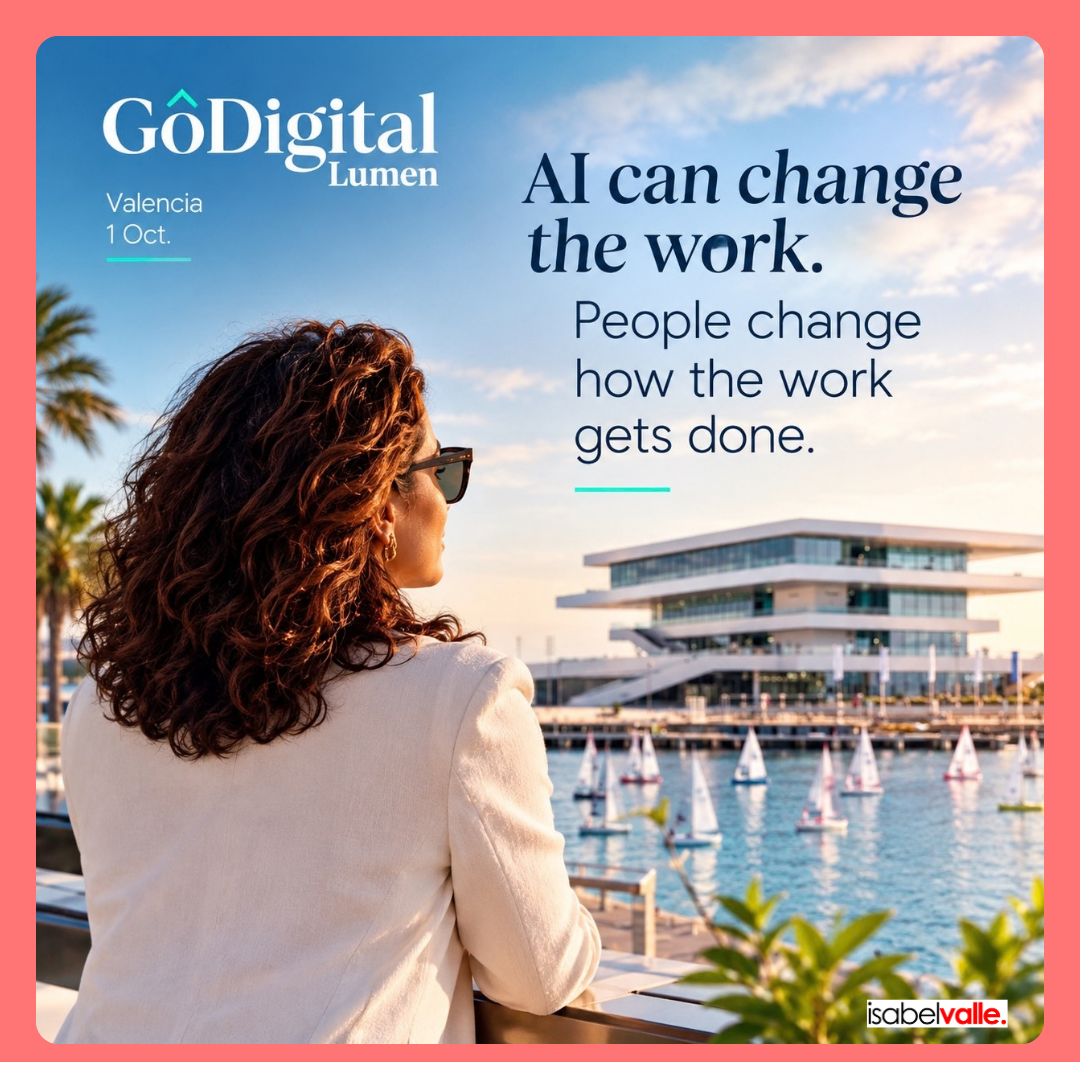
Yesterday, I attended GoDigital Lumen 2026 at Veles e Vents in Valencia, an event focused on artificial intelligence, digital transformation, automation, innovation and the future of business.
It was a beautiful setting for a conversation about the future of work.
But one statistic in particular stayed with me.
According to McKinsey’s latest State of AI research, 80% of respondents say AI has improved their individual productivity.
Yet only 37% report that AI has contributed positively to their organisation’s EBIT.
And only around 6% of organisations qualify as AI high performers, attributing at least 5% of EBIT to AI and describing its impact as significant.
That gap is fascinating.
Because it tells us something important:
Making people faster is not necessarily making the organisation better.
Imagine an employee who previously spent three hours completing a task and can now do it in 30 minutes using AI.
That’s impressive.
But what happens to the other two and a half hours?
If they simply disappear into more meetings, additional approval processes, duplicated work, endless checking or an outdated workflow, the organisation hasn’t fundamentally changed.
The person has become more productive.
The system hasn’t.
And this is where I believe the conversation about AI transformation and leadership needs to go deeper.
We’re investing enormous amounts in AI software, platforms, automation and AI training.
But are we investing enough in the people who have to change the way work actually gets done?
Because successful AI adoption isn’t simply a technology challenge.
It’s a human challenge.
People need to develop new skills.
Managers need to lead differently.
Teams need to question established processes.
Roles and responsibilities may need to evolve.
And leaders need to create enough psychological safety for people to experiment, challenge assumptions and admit when something isn’t working.
McKinsey’s research points towards exactly this. The organisations seeing the greatest impact are more likely to redesign workflows, measure business outcomes and rethink how work operates end-to-end rather than simply adding AI to existing processes. Nearly 75% of AI high performers report redesigning workflows, compared with 25% of other organisations.
This is where my work as a Master Coach and Global Leadership Strategist increasingly intersects with AI.
Because the question isn’t only:
“What AI should we buy?”
It’s also:
“How do our people need to think, behave and work differently because of it?”
That requires more than technical training.
It requires conversations about mindset.
Confidence.
Leadership.
Change.
Decision-making.
Collaboration.
Trust.
And, perhaps most importantly, letting go of old ways of working that no longer make sense.
AI can change what is possible.
But people determine what actually happens.
The organisations that create real value from AI won’t simply be the ones with the most sophisticated technology.
They’ll be the ones capable of bringing technology, people, leadership and redesigned ways of working together.
That is the conversation I believe we need to have now — not when the technology is already embedded and people are struggling to catch up.
How are you preparing your leaders and teams to work successfully alongside AI?
If you’re investing in AI and want to explore the human and leadership side of AI transformation, I’d love to have a conversation.
Because the future of work isn’t AI versus people.
It’s about creating workplaces where AI and people make each other better.
To your success,
Isabel

Isabel Valle is a Global Leadership Strategist and ICF Master Certified Coach (MCC) who helps senior leaders and organisations achieve high performance without losing their humanity.
With 25+ years of international leadership experience across Europe, Australia and Asia, Isabel combines strategic thinking, executive coaching and real-world leadership experience to help leaders build stronger leadership, high-performing teams and cultures where people can thrive.
She is the creator of LeadWise™ – Radically Human Leadership, a leadership philosophy grounded in the belief that sustainable performance starts with how we lead ourselves, develop others and shape the environments around us.
A keynote speaker, author and award-winning leadership expert, Isabel works with leaders who don’t simply want to perform better — they want to lead better, and make a lasting impact.
