
Your Managers Aren’t Failing. We May Be Asking Them to Do an Impossible Job.

There is something we don’t talk about enough in leadership.
Managers are tired.
Not necessarily because they are poor managers. Not because they lack commitment. And certainly not because they don’t care.
Many are tired because we’ve gradually turned the role of manager into something almost impossible.
Deliver the numbers.
Develop your people.
Manage performance.
Keep everyone engaged.
Handle difficult conversations.
Lead transformation.
Navigate uncertainty.
Embrace AI.
Protect wellbeing.
Influence senior stakeholders.
And somehow remain calm, inspiring and available throughout it all.
Then we wonder why managers are struggling.
The latest Gallup State of the Global Workplace report found that manager engagement has fallen to just 22%, nine points lower than in 2022. Gallup also found that managers play a particularly important role in successful AI adoption: employees are significantly more likely to use AI frequently when their managers actively support its use.
So managers aren’t becoming less important.
If anything, they’re becoming more important.
But we may be asking them to carry too much.
The Hidden Leadership Problem
One of the patterns I see repeatedly when coaching leaders is what I call the responsibility trap.
A capable manager sees a problem.
They solve it.
Someone asks a question.
They answer it.
A team member struggles.
They step in.
A difficult conversation appears.
They handle it.
It feels like leadership.
And initially, it works.
But something unintended happens.
The team learns to depend on them.
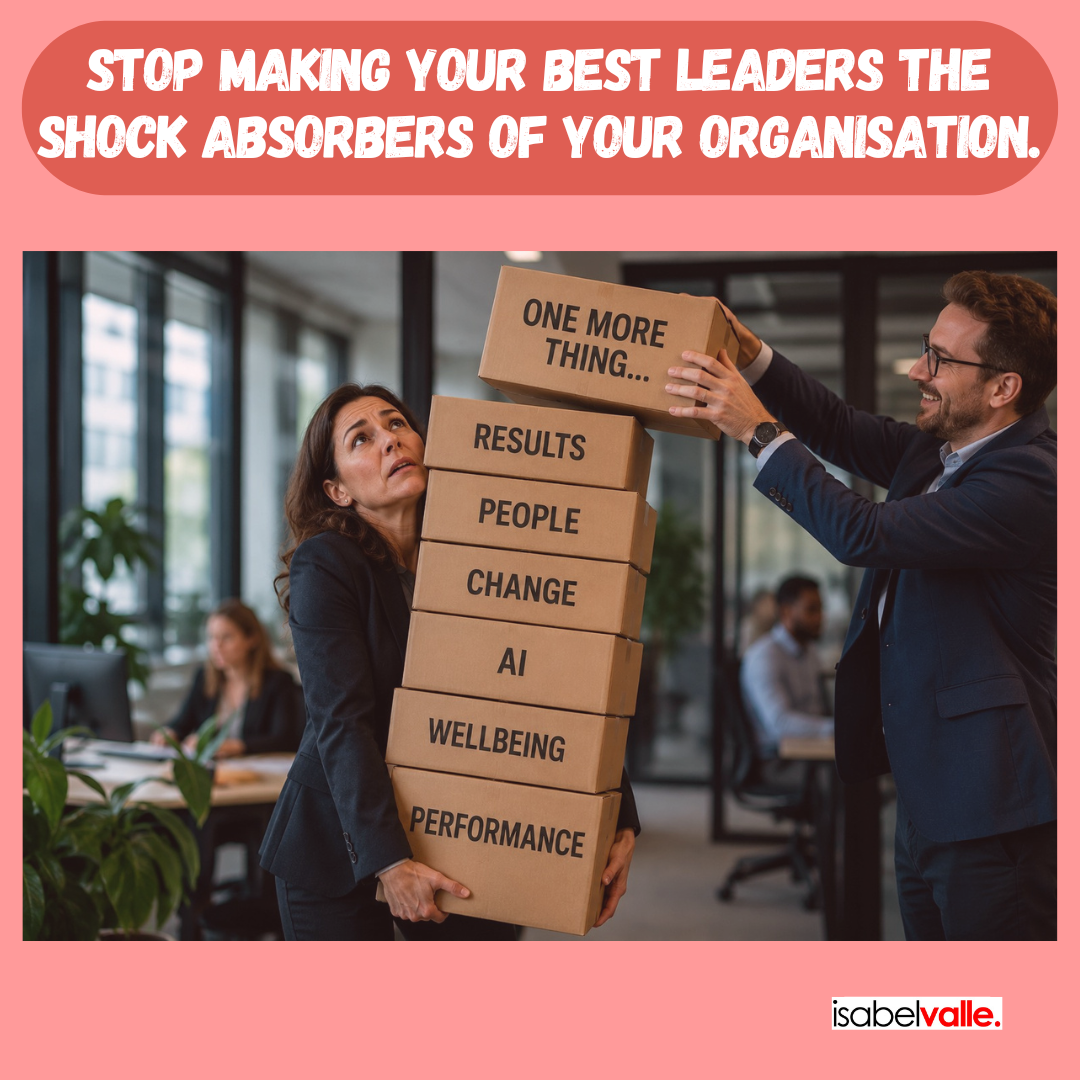
The manager becomes the decision-maker, problem-solver, emotional support system and organisational shock absorber.
Eventually, everyone is busy.
But nobody is becoming more capable.
That’s not sustainable high performance.
That’s dependency.
Your Job Isn’t to Carry Everything
One of the most important shifts I work on with leaders is moving from:
“How can I solve this?”
to:
“How can I help my team become capable of solving this?”
Those are completely different questions.
The first creates dependency.
The second creates ownership.
Imagine a team member comes to you with a problem.
Instead of immediately giving them the answer, try asking:
“What do you think we should do?”
Then:
“What options have you considered?”
And perhaps:
“What would you decide if I wasn’t here?”
You’re not abandoning them.
You’re developing them.
The Nervous System Matters Too
There is another piece we often overlook.
An overloaded leader doesn’t simply become less productive.
They can become more reactive.
When pressure rises, our capacity for patience, perspective and thoughtful decision-making can shrink.
That matters enormously in leadership.
Because your emotional state doesn’t stay with you.
It travels.
A leader who constantly operates in urgency can create a team that operates in urgency.
And eventually urgency becomes the culture.
This is why sustainable high performance requires more than targets and accountability.
It requires leaders who have enough capacity to think, listen, regulate themselves and make intentional choices.
So What Needs to Change?
Perhaps we don’t need managers who work harder.
We need organisations that design better leadership environments.
Managers need clarity about what really matters.
They need permission to delegate.
They need development that changes behaviour—not another presentation about leadership.
And they need to understand that their value isn’t measured by how much they personally carry.
The best managers don’t become indispensable.
They make themselves progressively less necessary for the things their teams are capable of doing.
That is leadership.
And perhaps the question we should all be asking is:
**Are we developing our managers…
or simply asking them to survive?**
Because if we want sustainable high performance, we can’t keep treating exhausted leaders as the solution to organisational pressure.
We have to stop making leaders the shock absorbers of the system—and start making them the architects of healthier, higher-performing teams.
To your success,
Isabel
Which inisght has impacted you the most? Drop it in the comments!

Isabel Valle is an award-winning Global Leadership Strategist and ICF Master Coach, dedicated to helping executives and business leaders achieve sustainable success. Through her acclaimed programs like Leadership Reimagined and Lead365, Isabel equips leaders with the tools to foster innovation, build high-performing teams, and thrive in a fast-evolving world. A sought-after speaker and author, Isabel blends data-driven insights with a human-centered approach to deliver transformative results. Learn more at www.isabelvalle.com.