
Is Workplace Safety Becoming a Thing of the Past?

Can I speak honestly here?
Can I disagree with my boss?
Can I admit I made a mistake?
Will my job still exist in two years?
Will AI replace what I do?
These questions would rarely have been included in our traditional definition of workplace safety.
Safety used to mean protection from physical harm.
But the world of work has changed.
And perhaps our definition of safety needs to change with it.
The workplace is becoming less predictable
Technology, artificial intelligence, economic uncertainty, restructuring and changing business models are reshaping work at extraordinary speed.
The World Economic Forum’s Future of Jobs Report 2025 estimates that structural labour-market transformation could affect 22% of today’s jobs by 2030, with 170 million new roles created and 92 million displaced.
That doesn’t mean 92 million people will simply lose their jobs.
It does mean that the relationship between people and work is changing.
Roles will evolve.
Skills will become obsolete faster.
New skills will become valuable.
Some responsibilities will disappear.
Others will be created.
And organisations will continue to restructure.
The result?
Uncertainty.
And uncertainty affects people.
The American Psychological Association’s 2025 Work in America survey found that 54% of U.S. workers said job insecurity has a significant impact on their stress levels.
This isn’t simply an employee wellbeing issue.
It is a leadership issue.
Safety is becoming psychological as well as physical
The European Agency for Safety and Health at Work identifies psychosocial risks including excessive workload, lack of role clarity, lack of involvement in decisions, poorly managed organisational change, job insecurity, ineffective communication and lack of support from managers or colleagues.
The International Labour Organization similarly recognises job security, workload, work pace, organisational culture and interpersonal relationships as factors that can affect mental health at work.
And the scale matters.
The WHO and ILO estimate that depression and anxiety result in 12 billion lost working days every year, at an estimated global economic cost of almost US$1 trillion.
So workplace safety is no longer simply:
“Will I get physically hurt here?”
It can also mean:
“Can I speak here?”
“Can I make a mistake here?”
“Can I disagree here?”
“Can I ask for help here?”
“Can I adapt here?”
“Can I build a future here?”
What happens when people don’t feel safe?
They don’t always resign.
Often, they protect themselves.
They become quieter.
They stop challenging ideas.
They avoid taking risks.
They keep concerns to themselves.
They do exactly what they are asked — and nothing more.
This is why psychological safety matters.
It isn’t about making everyone comfortable.
It is about creating an environment where people can tell the truth, ask questions, challenge assumptions and learn from mistakes without fear of humiliation or retaliation.
And in a world of constant change, that capacity becomes increasingly important.
What can you do?
If you’re a leader
Make uncertainty open for discussion.
Don’t pretend you have every answer. Tell people what you know, what you don’t know and when you expect to know more.
Make disagreement safe.
If everyone agrees with you all the time, you may not have alignment. You may have silence.
Explain the “why” behind change.
People cope better with change when they understand what is happening and have some influence over how they respond.
Invest in adaptability.
Don’t just train people for today’s role. Help them develop the skills they will need for tomorrow’s work.
If you’re an employee
You also need to build your own resilience.
Know your strengths.
Keep learning.
Build relationships outside your immediate organisation.
Keep a record of your achievements.
Maintain your professional network.
Keep your CV and LinkedIn profile current.
And understand your financial options if circumstances change.
This isn’t about becoming paranoid.
It is about becoming prepared.
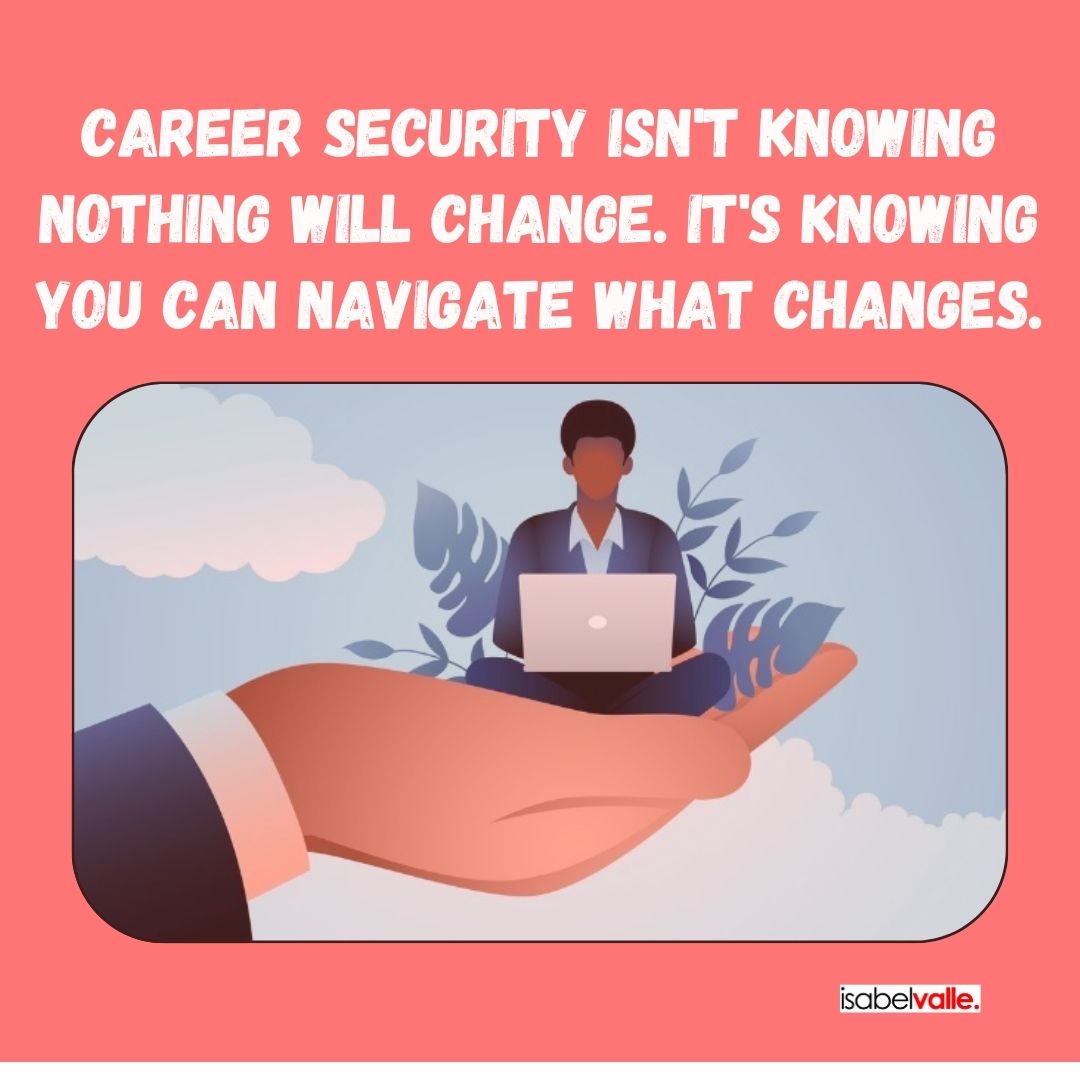
Because career security may no longer mean having a job that never changes.
It may mean having the clarity, capability and confidence to navigate change when it does.
And perhaps that is the new definition of workplace safety:
“Career security isn’t knowing nothing will change. It’s knowing you can navigate what changes.”
The question for leaders is therefore not simply:
“Is my workplace safe?”
It is:
“Do the people who work here feel safe enough to tell me the truth — and capable enough to navigate what comes next?”
That is a very different leadership question.
And increasingly, it may be one of the most important ones.
To your success,
Isabel

Isabel Valle is a Global Leadership Strategist and ICF Master Certified Coach (MCC) who helps senior leaders and organisations achieve high performance without losing their humanity.
With 25+ years of international leadership experience across Europe, Australia and Asia, Isabel combines strategic thinking, executive coaching and real-world leadership experience to help leaders build stronger leadership, high-performing teams and cultures where people can thrive.
She is the creator of LeadWise™ – Radically Human Leadership, a leadership philosophy grounded in the belief that sustainable performance starts with how we lead ourselves, develop others and shape the environments around us.
A keynote speaker, author and award-winning leadership expert, Isabel works with leaders who don’t simply want to perform better — they want to lead better, and make a lasting impact.